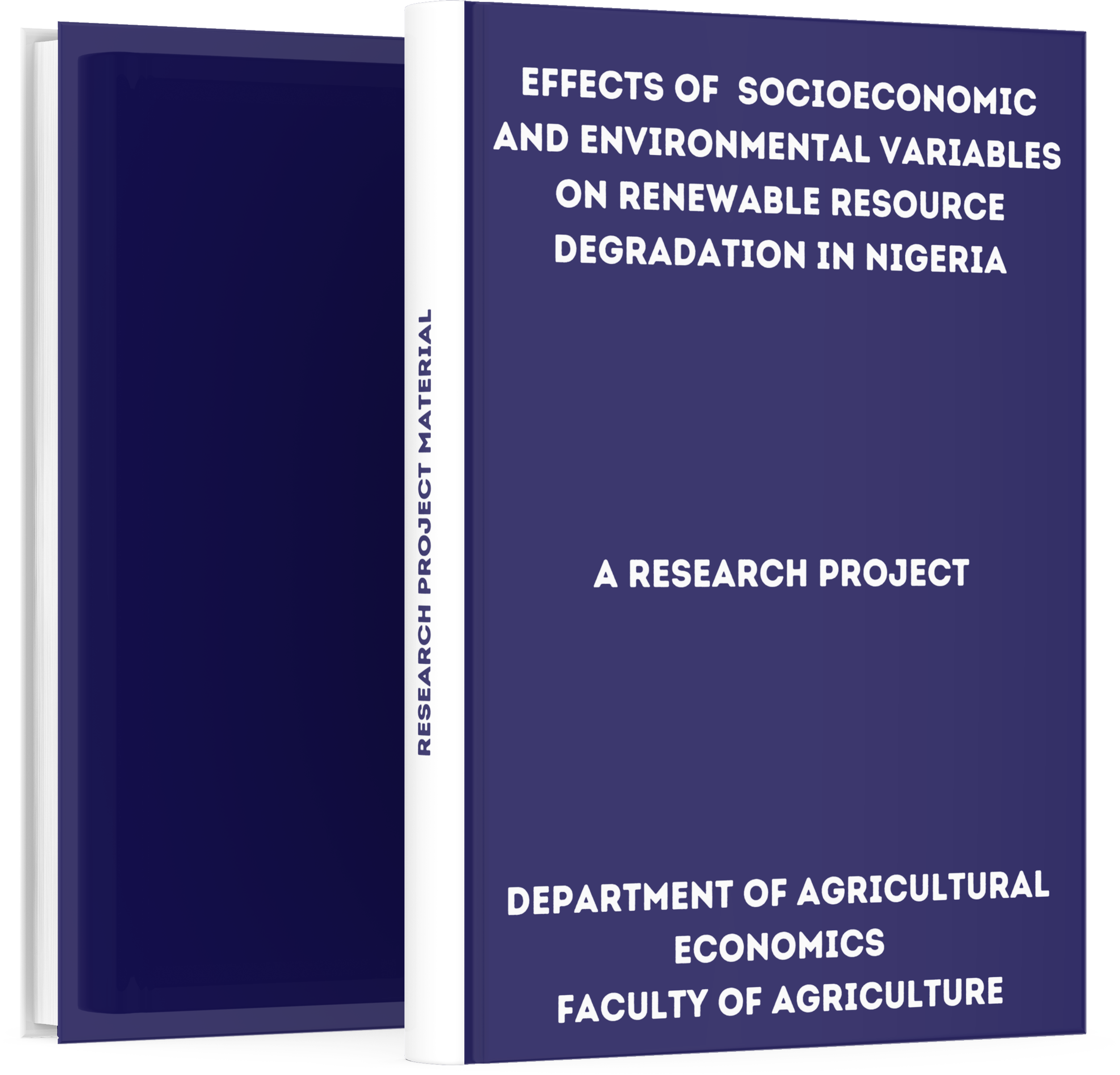
Effects of Socioeconomic and Environmental Variables on Renewable Resource Degradation in Nigeria
₦3,000.00
If you are interested in getting this project material “Effects of Socioeconomic and Environmental Variables on Renewable Resource Degradation in Nigeria”, click on the DOWNLOAD BUTTON to make payment and the file will be delivered to your email immediately after confirmation.
Description
– Effects of Socioeconomic and Environmental Variables on Renewable Resource Degradation in Nigeria –
Download Effects of Socioeconomic and Environmental Variables on Renewable Resource Degradation in Nigeria. Agricultural Economics students who are writing their projects can get this material to aid their research work.
Abstract
Nigeria is faced with many environmental problems. Available data indicate that Nigeria is losing her renewable natural resources (including arable land, forest, pasture/rangeland and water resources) beyond sustainable limits.
Economic and environmental systems interact in many important ways and hence the need to understand these interactions and develop effective public policy.
While economic systems derive many invaluable inputs (some commodified, others free) from environmental systems and processes, economic activity can have negative impacts on the functional integrity of these natural systems and processes.

Introduction
There exists a delicate balance between economics and the environment and for several decades now, the challenge of achieving accelerated growth and poverty reduction while conserving the natural environment especially in poor countries has occupied the attention of policymakers and researchers.
This global desire is expressed in many environment and development conferences including the environmental conference in Stockholm in 1972 and the World Commission on Environment and Development (WCED) in 1987 (which produced the landmark Brundtland Report:
Our Common Future). Others include the UN conference on Environment and Development (UNCED) in Rio de Janeiro in 1992,the “Earth Summit” (which produced the Agenda 21 action plan for development and the Rio Declaration on environmental protection and responsible development),
The Millennium Summit in New York in September 2000 producing the MDGs, and the World Summit on Sustainable Development (WSSD) in Johannesburg in 2002 (CROP, 2005; Evans, 2004; Ralph & Roper, 2005).
How to Download this Project Material
First, note that we are one of the best and most reliable online platforms because we don’t retain any of your personal information or data as regards making payments online.
PRICE: ₦3,500 ₦3,000 (Three Thousand Naira Only)

Make a bank deposit or mobile transfer of ₦2,000 only to the account given below;
Bank Name: UBA Account Number: 1022564031 Account Name: TMLT PRO SERVICES
After making the payment, CLICK HERE to send the following on WhatsApp;
- Depositor’s Name or Screenshot of Payment
- Name of the Past Question
- Active Email Address
or Call Us On +2348082284439 Once your details have been received and your payment confirmed by us, you will receive the past question in your email or WhatsApp within 5 Minutes.
Guarantee of Getting the Material
We understand that due to the high rate of fraud, many people are afraid of making purchases online but be rest assured that PastExamQuestions will deliver your material after payment.
Once your details have been received and your payment confirmed by us, you will receive the past question in your email or WhatsApp.
Give us Feedback
Have we been able to satisfy you? How well do you think the material will be helpful after having gone through it? Does the price worth the material?
Let’s hear from you! We recommend that our customers give feedback at the end of every transaction to enable us to serve better. You can do this by clicking the review button on this page.
Where is the review button? >> Just scroll up to where you see reviews

Reviews
There are no reviews yet.